
Short answer
These are free one-page A4 OPD card templates for clinics in Thailand, in three versions: general practice, dental and aesthetic. Each carries the eight items the 2002 Ministerial Regulation requires, marked with a dot, plus the fields clinics rely on, such as drug allergies, vital signs and the next appointment. Labels are in Thai and English.
Key points
- Thai law requires eight items on an OPD card; every other field on these templates is recommended and can be removed.
- The drug allergy box sits right under the patient's details. Tick None or Yes every time: a blank box means nobody asked.
- The dental card adds an FDI tooth chart for permanent and primary teeth; the aesthetic card adds a course table and a product lot column.
- Nursing, Thai traditional medicine and physiotherapy clinics can use the general card, because the eight required items are the same for every licensed facility.
- Completed cards must be kept for at least five years from the date they were made.
Which OPD card template should you download?
Pick the one that matches what your practitioners record at each visit. All three are one-page A4 portrait PDFs with the same header, patient details and drug allergy box; only the lower half differs.
The general practice card holds two full visits per page: vital signs, complaint, history and examination, diagnosis with an ICD-10 code, treatment and the next appointment. The dental card has a tooth chart and a treatment log by tooth. The aesthetic card has a table for the courses a patient has bought and a procedure log with columns for product, lot number and amount.
Every label is in Thai with an English gloss. The facility name is left blank for your rubber stamp or handwriting, so you can photocopy the card as it is. The templates are free to use and edit.
Which fields does Thai law require, and which are optional?
The fields marked with a dot are the eight items required by clause 3 of the Ministerial Regulation on evidence concerning practitioners in medical facilities and patients, B.E. 2545 (2002). It applies to every clinic licensed under the Medical Facilities Act. No law requires the other fields; they are there because practitioners need them to treat.
To shorten the card, remove only unmarked fields. To add your own, put them in the lower half and leave the marked fields where they are.
| Field | Required or recommended | What it is for |
|---|---|---|
| Facility name | Required | Shows which clinic the record belongs to |
| Patient number (HN) | Required | Finds the file and ties every visit to the same patient |
| Visit date | Required | Starts the five-year retention period, counted from the date the record is made |
| Name, age, sex, address, national ID, nationality, ethnicity, marital status | Required | The personal details that identify the patient |
| Chief complaint, present illness, examination, lab results | Required | The basis for the diagnosis. If nothing was sent to a lab, write so |
| Diagnosis | Required | Add the ICD-10 code next to the name, so past visits and reports are easy to pull |
| Treatment and medication | Required | Drug, strength, directions and quantity, so the next practitioner knows what was given |
| Practitioner's signature | Required | Shows who treated. The licence number next to it is recommended |
| Drug allergies | Recommended | Must be seen before every prescription |
| Chronic conditions and current medication | Recommended | Inform the choice of drug and procedure |
| Vital signs | Recommended | Examination findings that can be measured and compared visit to visit |
| Coverage and emergency contact | Recommended | Needed for billing, and for reaching family or referring the patient |
| Advice and next appointment | Recommended | Tell whoever sees the patient next why they were asked back |
How long to keep OPD cards, and moving them into records software
Example: a filled-in general practice OPD card
The example is a fictional patient with a sore throat. Green text is what the clinic wrote; the ID and phone numbers are masked with x so the format shows.
Three things real cards often get wrong. The allergy box needs the drug and the reaction, not just the word allergic. An empty field should say none or not sent, so the next reader knows the question was asked. And the diagnosis should carry its ICD-10 code, with the practitioner signing and adding a licence number at every visit.
The HN in the example is a two-digit Buddhist-era year followed by a running number. Any format works, as long as numbers are never repeated or reused.
What a dental OPD card adds
Three things: the medical history a dentist needs before any procedure, a tooth chart, and a treatment log that records the tooth and surface. The header, patient details and allergy box are the same as on the general card.
The chart uses FDI two-digit numbering: 11 to 48 for the 32 permanent teeth and 51 to 85 for the 20 primary teeth. The first digit is the quadrant, the second the position counted from the midline. It is drawn as the dentist faces the patient, so the left of the chart is the patient's right, and each tooth has five surfaces to shade where there is decay or a filling.
Clinics that treat Social Security or Universal Coverage patients record that in the coverage field. Claim rules for each scheme come from the agency that runs it.
| วันที่ Date (กฎหมายกำหนด, required by law) | ซี่ ด้าน Tooth, surface | อาการและสิ่งที่ตรวจพบ History and findings (กฎหมายกำหนด, required by law) | การวินิจฉัย Diagnosis (กฎหมายกำหนด, required by law) | การรักษา Treatment (กฎหมายกำหนด, required by law) | ลายมือชื่อ Signature (กฎหมายกำหนด, required by law) |
|---|---|---|---|---|---|
What an aesthetic clinic OPD card adds
Three things the general card lacks: screening questions before a procedure, a table of the courses the patient has bought, and a procedure log that records the product, lot number and amount used. The lot number lets you find every patient who received a batch if that batch is ever recalled.
The screening questions cover what a practitioner weighs before deciding to go ahead, such as pregnancy or breastfeeding, blood thinners, isotretinoin, keloid scarring or a history of cold sores. Tick them before each new course.
Photo consent is split in two, because before-and-after photos for the record and photos used in advertising are different things. Using health data beyond treatment, such as putting photos in an advert, needs the patient's explicit consent under section 26 of the Personal Data Protection Act B.E. 2562 (2019). If your clinic already has a separate consent form, that form takes precedence.
Course receipts have their own wording required by the Office of the Consumer Protection Board, separate from this card.
| คอร์ส Course | จำนวนครั้ง Sessions | วันที่ซื้อ Bought | หมดอายุ Expires | เลขที่ใบเสร็จ Receipt no. |
|---|---|---|---|---|
| วันที่ Date (กฎหมายกำหนด, required by law) | ตรวจพบและวินิจฉัย Findings, diagnosis (กฎหมายกำหนด, required by law) | หัตถการและบริเวณ Procedure, area (กฎหมายกำหนด, required by law) | ผลิตภัณฑ์ ล็อต ปริมาณ Product, lot, amount | ครั้งที่ Session | ภาพ Photo | ลายมือชื่อ Signature (กฎหมายกำหนด, required by law) |
|---|---|---|---|---|---|---|
Sources
Nursing, Thai traditional medicine, physiotherapy and children's clinics
Use the general card. The 2002 regulation sets the same eight items for every type of licensed facility, and the signature line says practitioner, not doctor, so a nurse, Thai traditional medicine practitioner or physiotherapist signs with their own licence number.
Write what your profession examines and does in the examination and treatment fields: nursing procedures, Thai traditional medicine findings, herbal formulas or home exercises. Once the same headings recur at every visit, print them onto your own version of the card.
Children's clinics record weight and height in the vital signs at every visit, and put a parent's name in the emergency contact field.
A clinic that is a contracted unit under the National Health Security Office, such as a community nursing clinic, records and submits whatever its NHSO agreement requires on top of this card. Check with the NHSO regional office that holds the agreement.
When to stop using paper cards, and what SyncEdge Clinic records instead
Stop when finding files and reading handwriting starts eating into consultation time, or when more than one practitioner needs the same patient's history. Paper is lawful: clause 6 of the 2002 regulation allows records on paper or on a computer, and if they are on a computer, a 2015 Ministerial Regulation requires a backup system.
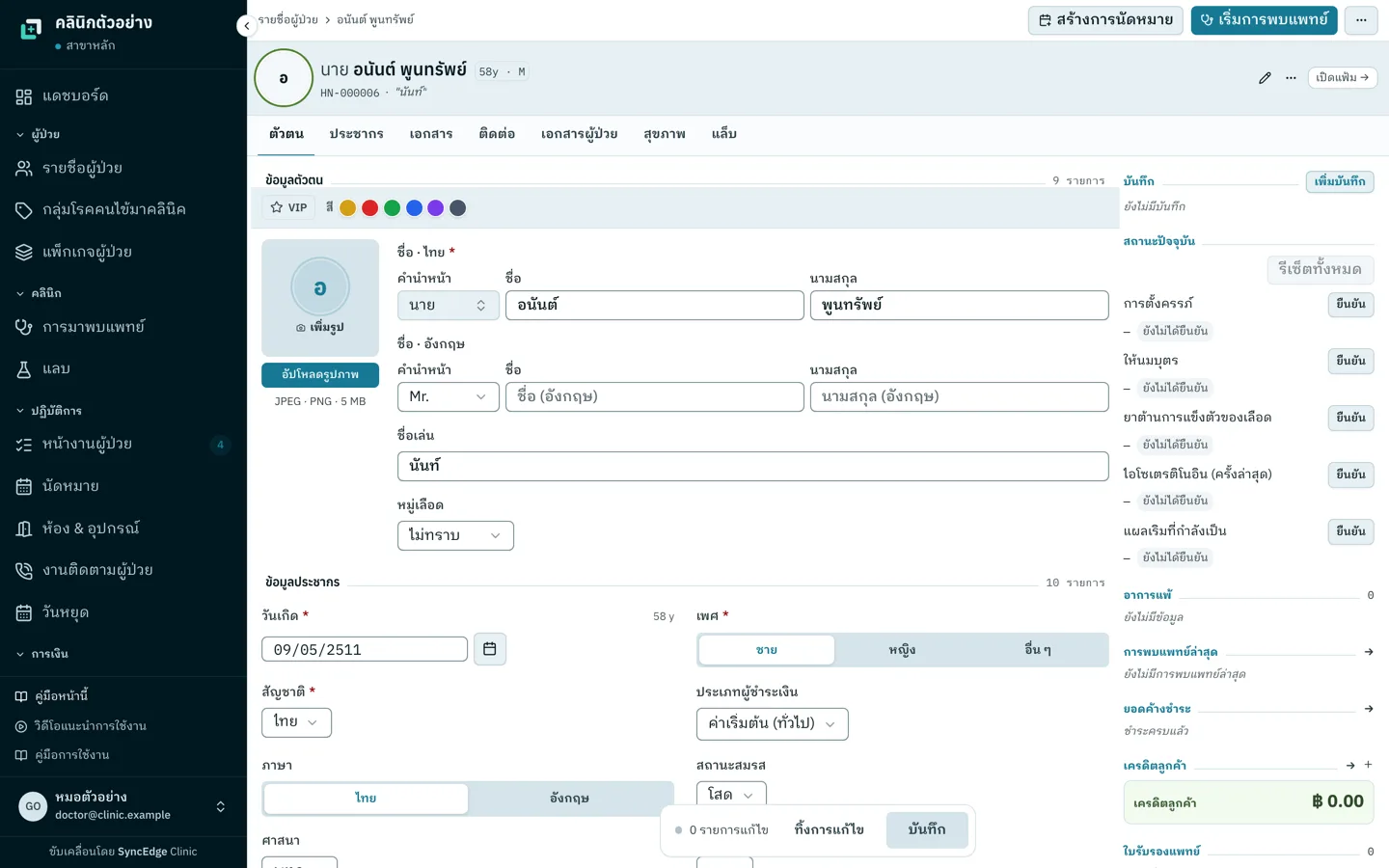
SyncEdge Clinic records the same fields as this card. Patient details sit in a patient file with an automatic HN, and can be read from a Thai ID card if a card reader and its bridge program are installed on that computer. Drug allergies are recorded once on the patient, with the drug, the reaction and its severity. When a practitioner prescribes, the system checks the allergy list before saving; a contraindicated or major warning can only be overridden with a written reason.
Each visit has the chief complaint taken at check-in, vital signs (blood pressure, pulse, temperature, oxygen saturation, weight and height, with BMI calculated on the visit summary), free-text consultation notes, an ICD-10 diagnosis and the treatments and drugs ordered. The system records which practitioner saw the patient. Once a visit is closed, any change to the record needs a reason, and the system keeps who changed what and when.
Aesthetic clinics attach before-and-after photos to each procedure, and every clinic type can sell courses and deduct a session at each visit, with remaining sessions and the expiry date in view.
Two things it does not do yet: there is no electronic signature on visit records, and scans of old paper cards cannot be attached to a patient file. Old cards stay on paper, or as separate scans, until their five years are up.
Medical records are in every plan. Plans start at Solo, ฿990 a month including VAT, with a two-month free trial and no credit card.
Paper card
- Someone fetches the file from the cabinet at every visit
- The practitioner has to check the allergy box before prescribing
- Only the person holding the file can read it
- Corrections are visible, but not who made them
SyncEdge Clinic
- Find the patient by HN or name
- Allergies checked against the prescription before it saves
- Staff with access open the same file from different computers
- Changes after a visit closes need a reason and are logged
Sources
Before you print your first batch of OPD cards
- The clinic's name is stamped or printed in the header; the facility name is one of the eight required items
- You have agreed an HN format and log each number issued in the outpatient register the same regulation requires
- Everyone who signs the card knows to add their licence number
- Staff tick the allergy box at every visit, even when the patient has no allergies
- There is a secure, stable cabinet or shelf where files are easy to find
- You know cards must be kept for at least five years from the date they were made
- If you will use before-and-after photos in advertising, you have a separate consent form
Frequently asked questions
Can I use these free OPD card templates in a real clinic?
Yes. All three carry the eight items clause 3 of the 2002 Ministerial Regulation requires. Stamp or print your clinic's name in the header and photocopy. They are free to use and edit; if you remove fields, remove only those without a dot.
Is there a Word or Excel version of the OPD card?
Not at the moment; the templates are A4 PDFs. To put your clinic's name or logo in the header, open the file in a PDF editor and type into the facility name field, or rubber-stamp the master copy before photocopying.
Should an OPD card be portrait or landscape?
The law does not specify. These templates are A4 portrait because they fit standard A4 folders and cabinets and go through a sheet-fed scanner without rotating. Landscape gives wider log columns but has to be turned to read in a folder. Choose whatever your folders and cabinets take.
How do you correct a mistake on an OPD card?
Strike through the original once so it stays legible, write the correction beside it, and initial and date the change. Never use correction fluid or tape, and never tear up a card to rewrite it: the original entry is the evidence of what was recorded.
Why are the labels in both Thai and English?
Clinic staff in Thailand work in Thai, while many practitioners and patients also read English. Each label carries both, so one card serves either reader; write in whichever language your clinic keeps its records.
Which tooth numbering does the dental OPD card use?
FDI two-digit numbering: the first digit is the quadrant, the second the tooth's position from the midline. Permanent teeth are 11 to 48 and primary teeth 51 to 85. The chart is drawn as the dentist faces the patient, so its left side is the patient's right.